
Food and wine pairings
Pouilly-Fumé: What Food and Wine Pairings?


Pouilly-Fumé: What Food and Wine Pairings?
There is a question we are regularly asked during our tastings: “What dish should I pair with a Pouilly-Fumé?” And the answer deserves more than a simple chart. It deserves understanding what this wine is — its origins, its subsoils, what it carries in the glass — so that the pairing you choose is truly yours.
Pouilly-Fumé is a Sauvignon Blanc from the right bank of the Loire, across from Sancerre. Same grape variety as the famous appellation, but a different voice. Denser, often rounder, with that mineral signature tasters describe as “gunflint”. A wine that cannot be confused with any other.
Famille Bourgeois has been producing wines from both banks of the Loire for generations. This guide is built from what we observe in our vineyards in Saint-Andelain and Saint-Laurent-l’Abbaye, and in the glasses of those who visit our estate.
Pouilly-Fumé takes its name not from a winemaking technique, but from a geological reality. The flint stones of Pouilly-sur-Loire and the surrounding area — those grey-white pebbles that crunch underfoot in the vineyards — imprint a smoky, mineral signature on the Sauvignon Blanc that Famille Bourgeois has learned to express in its wines.
Compared to a Sancerre, Pouilly-Fumé tends to be:
It is this difference in profile that guides the pairings. Where Sancerre is often more precise and vertical, Pouilly-Fumé is more enveloping: two wines with complementary roles.
Famille Bourgeois produces two Pouilly-Fumé wines with distinctly different personalities, grown on different terroirs of the appellation.
Pouilly-Fumé “En Travertin” comes from parcels on limestone-clay soils. These soils produce wines that are both round and fresh, aromatically expressive, with good depth on the palate. This is our cuvée of conviviality: it welcomes a wide range of dishes without imposing its terms.
“En Travertin” suits:
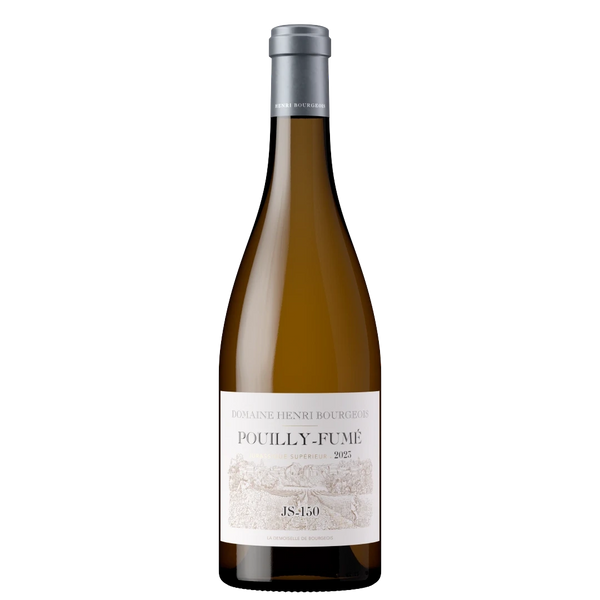
Pouilly-Fumé “JS-150” comes from parcels on Kimmeridgian marl (Upper Jurassic, 150 million years old), clay-rich soils full of marine fossils that produce wines of structuring tension and minerality. Deeper and more demanding, our “JS-150” calls for dishes that can match it.
“JS-150” suits:

This is the natural territory of Pouilly-Fumé. The density of the wine balances the texture of fatty fish; its smoky minerality extends the iodized flavors of crustaceans.
Oysters are the precision pairing of Pouilly-Fumé “JS-150”. The iodized salinity of the shellfish resonates with the stony minerality of the wine — an almost perfect similarity pairing. Serve “JS-150” at 50–52°F (10–11°C) so the mineral tension stays vibrant
Other shellfish that work well: clams, cockles, pan-seared scallops.
Lobster, langoustines, crayfish: the gentle, slightly iodized flesh of crustaceans opens up with the volume of Pouilly-Fumé “En Travertin”. If the crustacean comes with a butter reduction sauce, the richness of the sauce is brightened by the wine's freshness.
Salmon, mackerel, swordfish: fatty fish need a wine that won't be overwhelmed. The structure of “JS-150” stands up to the richness; the roundness of “En Travertin” softens the intense flavors of seared salmon. Pouilly-Fumé has that slightly smoky note that creates an almost mirror pairing with smoked salmon.
On a seafood platter or a fish soup, “JS-150” is our first choice. Its mineral tension carries through the whole meal without losing steam.
| Dish | Recommended Cuvée | Pairing Logic |
|---|---|---|
| Oysters and clams | “JS-150” (Kimmeridgian marl) | Iodized minerality — similarity |
| Seared scallops | “En Travertin” (limestone-clay) | Sweetness / roundness — similarity |
| Lobster and langoustines | “En Travertin” (limestone-clay) | Density / freshness — complementarity |
| Seared salmon (mi-cuit) | “JS-150” or “En Travertin” | Richness / acidity — complementarity |
| Smoked salmon | “En Travertin” (limestone-clay) | Smoky note — mirror pairing |
| Seafood platter | “JS-150” (Kimmeridgian marl) | Mineral tension / iodine — similarity |
Pouilly-Fumé is one of the rare white wines that truly holds its own against white meats in sauce. Its density keeps it from disappearing next to the richness; its acidity cleanses the palate between bites.
Veal blanquette is the reference pairing. The creamy sauce calls for the roundness of “En Travertin”; the delicacy of the veal matches the precision of the wine. If the blanquette is more structured, with a reduced sauce, “JS-150” brings the tension it needs.
With a simply seasoned roast chicken, “En Travertin” is our first choice. The roundness of its limestone-clay soils complements the tender flesh of the poultry without weighing it down. On chicken in a cream sauce, “JS-150” shows more of its structure.
Pork tenderloin, roast pork loin, coq au vin blanc: these dishes fully welcome a Pouilly-Fumé. The density of the wine balances the richness of the meat; its minerality lifts the cooking juices.
Sauvignon Blanc has a natural affinity with goat cheese — it's a terroir pairing, a geographical and gustatory given. But Pouilly-Fumé also opens up to other cheese families.
The deepest pairing with Pouilly-Fumé. A well-aged goat cheese — wrinkled rind, dry paste, intense flavors — calls for the tension of “JS-150”. The wine's minerality speaks to the concentrated lactic notes of the cheese; its acidity cuts through the richness. If the cheese is milder and less aged, prefer the roundness of “En Travertin”.
Aged Comté (24 months and beyond) is a surprise: its notes of hazelnut, cooked butter, and umami resonate with the mineral depth of “JS-150”. It's a bold pairing that works remarkably well. Abondance and Beaufort follow the same logic.
Very pungent cheeses — Livarot, Maroilles, Époisses — risk overpowering the wine. If you do serve them, choose “JS-150” and serve the cheese at room temperature, in small quantities.
This is the unexpected pairing — and often the most memorable one. Asian cuisine, with its umami flavors, iodized notes, and delicate textures, is an ideal partner for Pouilly-Fumé. Our sister estate Clos Henri in Marlborough (New Zealand) excels at these pairings thanks to its tropical intensity — but our right-bank Pouilly-Fumé wines have their own answer to offer.
Tuna or salmon sashimi with “JS-150”: the wine's iodized minerality resonates with the freshness of the raw fish. The wine's tension cleanses the richness of the red tuna between bites. Serve at 50–52°F (10–11°C).
Spring rolls, sea bass larb, light noodle soups: “En Travertin” brings the roundness needed to stand up to fresh herbs and ginger without being overwhelmed by mild chilies.
Steamed dumplings, shrimp in delicate soy sauce, wontons: “JS-150” holds up well on these dishes, provided the sauces aren't too sweet. Avoid heavily caramelized or sweet-and-sour recipes.
A successful pairing is built as much on what you avoid as on what you choose. Pouilly-Fumé is a wine of mineral precision — certain dishes destroy it.
FAQ
What's the difference between a Sancerre pairing and a Pouilly-Fumé pairing?
Sancerre tends to be more taut and vertical — ideal with grilled fish or raw preparations. Pouilly-Fumé, denser and rounder, opens up more to sauces, rich crustaceans, and dressed dishes. If a dish calls for a wine with body, choose Pouilly-Fumé. If it calls for a wine with precision, choose Sancerre.
Pouilly-Fumé “En Travertin” or “JS-150” for oysters?
“JS-150”, without hesitation. Its Kimmeridgian marl gives it a mineral tension and a finishing salinity that resonate directly with the iodine of the oyster. “En Travertin” is rounder — it suits scallops or langoustines better.
At what temperature should Pouilly-Fumé be served?
Between 50–54°F (10–12°C). Too cold (below 46°F/8°C), the aromas close up and the minerality disappears. Too warm (above 57°F/14°C), you lose the tension that makes the pairing work. Take the bottle out of the fridge 15 minutes before serving.
Can Pouilly-Fumé be paired with Asian cuisine?
Yes, and it's often a memorable pairing. “JS-150” with sushi and sashimi, “En Travertin” with delicate Thai or Vietnamese cuisine. Avoid very sweet or heavily spiced sauces that overpower the wine.
Can Pouilly-Fumé carry an entire meal?
Absolutely. Start with “JS-150” on iodized starters (oysters, tartare), then move to “En Travertin” for main courses built around fatty fish or poultry. For a single wine for the whole meal, “En Travertin” is the more versatile of the two.

A Bourgeois Family Recipe: Salmon en Bellevue

Which dry white wine is best for an aperitif? Our tips and selection

The 3 Terroirs of Sancerre: Flint, Caillottes, and White Soil